
Creative Agency vs Design Agency vs Content Agency – What’s the Difference?
The terms “creative agency”, “design agency” and “content agency” are often used interchangeably. It’s understandable. Design requires creativity, and one of the most common outputs of a creative agency is design. The same can be true of content agencies.
Yet, if you run a Google search for a local “creative agency” or head straight to ChatGPT, you might find references to web design studios, boutique content studios or video production houses. Search for a “design agency” and you could end up with branding specialists, UI experts, web designers or signage manufacturers. Same terms, wildly different deliverables.
To put the scale of this into perspective, the Department for Digital, Culture, Media and Sport (DCMS) estimated that Gross Value Added (GVA) by the UK’s creative industries reached £126 billion in 2022, which was up 12% in real terms from 2019. It’s an impressive figure, but when you break that total down, it becomes clear just how broad the label “creative industries” really is:
- IT, software and computer services – £55.4bn
- Film, TV, radio and photography – £20.8bn
- Advertising and marketing – £18.8bn
- Publishing – £11.6bn
- Music, performing and visual arts – £11.2bn
- Architecture – £3.7bn
- Design and designer fashion – £3.2bn
- Museums, galleries and libraries – £1.0bn
Every category is a catch-all to some extent, but the differences here are significant. Some sectors are primarily creative in output. Others are technical, commercial or service-led, yet they’re all grouped under the same umbrella. This is where some of the confusion around agency labels begins. An SEO or PPC agency may prioritise performance and optimisation over creative output, while a studio built around brand, design and content focuses on shaping how a business looks, sounds and feels, yet we’re often grouped under the same terminology.
The point is: these terms don’t mean much on their own. If you’re trying to choose between a design agency, a content agency and a creative agency, you need more than labels. You need clarity, and that’s where we can help.
What Does Each Type of Agency Actually Do?
Rather than getting caught up in labels, it’s more useful to think about the problem each type of agency is designed to solve. That’s usually where the real differences sit.
Creative Agency
A creative agency is typically focused on ideas, direction and positioning.
Their role often sits at the front end of a project: helping shape the message, define the narrative, and decide how a brand should show up. This can include brand strategy, campaign concepts, messaging frameworks and creative direction.
Creative agencies are most valuable when the challenge is unclear or open-ended, when a business knows it needs to communicate better but isn’t yet sure what to say or how to say it.
In short, a creative agency helps you answer the question:
“What should this be?”
Design Agency
A design agency is usually more focused on visual execution.
That might mean brand identity, graphic design, web design, UI/UX, print or packaging. The emphasis is on craft, clarity and consistency – taking an idea or brief and translating it into something tangible.
Design agencies tend to work best when there’s already a clear direction in place and the task is to bring it to life visually, to a high standard.
At its core, a design agency helps answer:
“How should this look?”
Content Agency
A content agency focuses on creation and consistency.
This often includes photography, video, social content, copywriting and ongoing production support. Content agencies are typically brought in when a brand needs to show up regularly across channels, particularly social, but doesn’t have the internal time or resources to do it well. They’re most effective when the brand already has a reasonably clear voice and direction, and needs help maintaining momentum.
This approach is closely tied to the principles of content marketing. Instead of focusing solely on individual campaigns or short-term advertising bursts, content marketing is about building long-term relationships with an audience through consistent, valuable outputs. We explore this in more detail in our blog on what content marketing is and why it matters, but the key idea is simple: brands grow by showing up regularly with content that informs, engages and adds value over time.
A content agency answers the question:
“How do we keep showing up?”
Where the Lines Blur
In reality, very few agencies sit neatly in one box.
- Creative agencies often design.
- Design agencies frequently create content.
- Content agencies are increasingly expected to think strategically.
This overlap is partly why the terminology has become so muddled and why two agencies with the same label can offer completely different experiences. It’s also why many businesses feel frustrated after hiring an agency that technically did the job but didn’t quite solve the problem they were trying to fix.
Why Hybrid Agencies Exist
Over time, brands have realised that separating thinking, design and content into silos can create friction.
- Strategy without execution struggles to land.
- Design without context can feel superficial.
- Content without direction quickly becomes inconsistent.
As a result, hybrid agencies have emerged, combining creative thinking, design and content creation under one roof. The aim isn’t to do everything, but to reduce handovers, preserve clarity, and ensure ideas actually carry through into what people see day-to-day.
So Where Does Content Craving Fit?
At Content Craving, we sit in that hybrid space. We’re creative-led, but grounded in execution. We help brands find clarity first, then turn that into consistent, considered creative. That might mean shaping ideas, designing assets, or capturing content, often all three, depending on what’s actually needed. This includes everything from visual identity work and design execution through to social media assets, copywriting, photography and day-to-day content output across advertising and marketing.
In reality, most brands don’t need just one of these things. They need consistency across all of them. A steady stream of content that feels aligned in tone, design and message across every platform. Our focus isn’t on ticking boxes or delivering isolated outputs. It’s on helping brands show up clearly, consistently and confidently, whether that’s through a one-off project or ongoing creative support.
How to Choose the Right Agency for You
If you’re deciding between a creative, design or content agency, a few simple questions can help:
- Do you need ideas and direction, or mainly execution?
- Are you launching something new, or improving what already exists?
- Do you need ongoing support, or a defined project?
- How important is consistency across channels?
- The clearer you are on the problem you’re trying to solve, the easier it is to find the right fit.
The History of Creative Agencies
The world’s first agency owner
The earliest seeds of the creative agency model can be traced back to 1786, when William Tayler, based in London, began operating as an “Agent of the Country Printers, Booksellers, etc.” This title, likely used in his advertisements, reflects the industry at the time, which included a mix of individual printers and larger publishing firms. Tayler operated as a middleman, helping businesses reach new audiences through printed media. Roll on 14 years, and James “Jem” White hit the ground running with ‘RF White & Son’ in Warwick Square, London. The company developed a reputation for crafting persuasive messaging, which is seen as a foundational element of the copywriting field.
In 1812, George Reynell opened one of the first full-service shops. His team handled everything from copywriting to media placement, and not long after, Charles Barker founded “Barkers,” which went on to thrive for nearly two centuries. In 1837, Charles Mitchell & Co. launched the Mitchell’s Press Directories – a handy guide to newspapers and their audiences that marked one of the earliest forays into what we’d now call market research.
Across the Pond: Early U.S. Agencies (1841-1869)
The agency idea didn’t stay confined to Britain for long. In 1841, Volney B. Palmer set up shop in Philadelphia, essentially importing Tayler’s bulk-buying, resale approach to the American market. And by 1869, the game shifted yet again when N.W. Ayer & Son became the first U.S. outfit to offer both ad space placement and in-house creative services—what we’d now recognise as a true full-service agency.
The Rise of the In-House Creative Team (1877–1890s)
As clients began to expect more than just space-booking, agencies started building dedicated creative departments. In 1877, J. Walter Thompson made headlines by hiring the first salaried copywriter. By the mid-1890s, Thompson’s had fully separated its “strategy and media” staff from the “concept, copy, and art” team—laying the groundwork for the modern agency structure of account managers, writers, and designers.
The Creative Revolution & Beyond (1960s–Today)
Fast-forward to the swinging ’60s, and you’ll find BBDO, Ogilvy & Mather, and Leo Burnett leading the charge in what became known as the “Creative Revolution.” Big, bold ideas and vivid visuals stole the spotlight, and agencies cemented their reputations as true partners in storytelling. From that point on, creativity was king—fueling the rise of agencies that seamlessly blend digital strategy, branding, design, and content under one roof.
Television Takes Centre Stage (1980s)
By the 1980s, TV advertising had become the dominant force in marketing. With Channel 4 launching in 1982 and commercial broadcasting expanding across the UK, brands had more opportunities than ever to reach mass audiences. Major brands began pouring larger budgets into television campaigns with agencies competing to create adverts that were bold, polished and unforgettable.
This decade also marked a shift towards celebrity partnerships, cinematic visuals and emotionally driven storytelling. Advertising became increasingly fast paced and more visually ambitious. Agencies expanded their expertise in creative production, audience targeting and media strategy as campaigns grew more complex and competitive.
Television quickly became the leading advertising platform, giving agencies a bigger stage to play with. Cinematic campaigns became a part of everyday life while agencies expanded into collaborative creative powerhouses made up of copywriters, art directors and strategists. This era cemented the idea that advertising could be entertaining as well as persuasive.
The Internet Changes Everything (1990s)
The arrival of the internet in the 1990s completely reshaped the advertising market. Early websites were relatively basic, with functionality taking priority over aesthetics. Brands quickly recognised the potential of digital spaces though. Agencies that once focused solely on print, radio and TV suddenly had to think about websites, banners, email campaigns and online customer journeys.
Logos and brand identity became even more important as companies fought to stand out in an increasingly crowded digital marketplace. Traditional agencies began hiring web designers and developers, marking the start of the modern digital agency model.
Digital Design Takes Off (2000s)
As internet technology advanced in the 2000s, agencies began creating far more interactive digital experiences. They embraced digital, richer website design, flash animations and visually engaging online campaigns that encouraged users to actively interact with brands rather than simply consume adverts passively. This decade also saw the growing demand for specialist digital skills. Creative agencies expanded beyond advertising into web development, branding, SEO and digital strategy, becoming multidisciplinary studios capable of managing entire online ecosystems.
Social Media and the Content Era (2010s-Today)
The rise of smartphones once again transformed advertising in the 2010s. Audiences shifted from desktop screens to mobile devices, forcing agencies to rethink everything from layout and typography to video formats and user experience. Responsive design became essential rather than optional.
Platforms like Instagram, YouTube and later TikTok increased influencer marketing, creator partnerships and always-on content creation. Brands were no longer speaking at audiences, they were expected to engage with them in real time through social media, comments, livestreams and reels.
Agencies adapted by bringing video production, copywriting, motion graphics, photography and social media management in-house. Creative teams were no longer focused solely on campaigns and became responsible for producing ongoing streams of content designed to build relationships, maintain visibility and keep brands culturally relevant.
As content has become a core part of how brands communicate, the focus has shifted from occasional campaigns to constant output. But producing more content doesn’t automatically mean producing better content. The most effective brands still rely on structure and clarity to guide what they create.
We explored this in more detail in our blog about thinking like a journalist, where we broke down how using the 5W’s – who, what, why, where and when – can help shape content that actually connects with audiences rather than simply filling the feed. It’s a simple framework, but it forces clarity, relevance and intent into every piece of content before it’s shared.
AI and Immersive Experiences (2020s)
Today’s creative agencies operate in an industry driven by algorithms, data and rapid content consumption. AI-powered tools have made design, copywriting and content production faster and more accessible, while personalised advertising has become more sophisticated than ever before.
Short-form video dominates social platforms, creating a demand for content. Brands are expected to publish consistently across multiple platforms, requiring agencies to develop efficient content creation workflows that balance speed, quality and authenticity. Content teams now work alongside strategists, designers and media specialists to create all sorts of content, including social videos, campaign copy, podcasts, branded content and creator collaborations.
Emerging technologies such as virtual reality (VR), augmented reality (AR) and mixed reality are beginning to reshape how consumers interact with brands. Modern agencies now balance automation with authenticity, using technology to scale creativity while still maintaining the human touch that audiences connect with most.
The Future of Advertising & Creative Agencies (Mid-Late 2020s)
Looking ahead, the next evolution of advertising is likely to centre around hyper-personalised experiences, virtual storefronts and AI-assisted branding. As technology continues to evolve, creative agencies will need to strike a careful balance between innovation and authenticity, embracing AI and automation as powerful creative tools rather than replacements for human insight.
Content creation will continue to sit at the centre of agency services. Brands increasingly need high volumes of platform-specific content. Success will depend not only on creating more content but also on creating content that is strategically aligned, creatively distinctive and genuinely valuable to audiences.
For example, a design agency might be tasked with rebranding a company. AI may be used to explore logo concepts, typography styles and colour systems, producing hundreds of variations in minutes. However, the final identity is not chosen by AI but is instead shaped by designers who understand the brand’s history, values, and audience, ensuring the end result feels intentional rather than automated.
The industry has already undergone decades of transformation, from print and TV to websites, social media and now AI-driven marketing. But while the platforms and technologies continue to change, the foundations of strong branding remain remarkably consistent. Clear positioning, memorable visual identities, authentic storytelling and genuine customer connection still sit at the heart of successful campaigns.
The agencies that thrive in the years will be those willing to explore emerging technologies while continuing to apply the timeless creative principles that build trust and long term brand loyalty. Because, regardless of how advanced advertising becomes, the most effective campaigns will always be the ones that tell a story that people can connect with.
Creative Strategy in 2026 – Why Agencies Still Need Human Insight
Today, creative strategy matters more than ever because AI has made content production faster and easier, but not necessarily smarter, more distinctive or more meaningful.
AI can generate copy, visuals, video concepts, social captions and campaign variations in seconds, but it cannot replace human understanding behind why a campaign should exist in the first place. A strong creative strategy gives direction to everything AI produces. It defines the brand’s voice, messaging, audience connection and overall identity. Without strategic thinking, AI-generated content can quickly become repetitive, generic and forgettable. As more brands use the same tools, originality becomes even more valuable.
Consumers are becoming more aware of AI-generated material. People still respond best to brands that feel authentic, emotionally aware and human. Strategy ensures campaigns connect with real behaviours, cultural moments and customer motivations rather than simply producing content for the sake of filling feeds with more posts, videos and advertisements.
In many ways, AI is shifting agencies away from spending time purely on production and towards higher-level thinking. The value agencies provide is no longer just creating assets. It’s defining campaign concepts, guiding content creation and ensuring every creative touchpoint contributes to a consistent brand story.
This is where agencies continue to provide value. While AI can accelerate production, agencies bring together strategists, designers, copywriters, content creators and marketers who understand how to translate business goals into ideas that resonate with real people. They combine creativity with commercial thinking, ensuring campaigns not only look good but also deliver meaningful results.
As advertising pioneer David Oglivly said, “If it doesn’t sell, it isn’t creative.”
The quote remains highly relevant today. Great creative work is not simply about producing attractive visuals or generating large volumes of content. It’s about creating meaningful connections that drive action, build trust and strengthen brand perception. The agencies that succeed in 2026 won’t necessarily be the ones using the most AI tools. They’ll be the ones combining AI efficiency with strong creative direction, brand understanding and human insight.
The Design Agency Deep Dive
If creative agencies help answer “what should this be?” design agencies are usually focused on “how should this look?”
Of course, it’s not quite that simple.
Many modern design agencies also think strategically. They help shape brands, improve customer experiences and influence how businesses are perceived. But at their core, design agencies are specialists in visual communication. Their job is to take ideas and turn them into something people can see, use and interact with.
How Design Agencies Evolved
The earliest design agencies were largely concerned with print. Logos, brochures, packaging, signage and advertising materials all needed to be designed consistently, particularly as brands expanded and competition increased. This shift reflected the growing importance of graphic design as a commercial discipline. As documented by Philip B. Meggs’ ‘Meggs’ History of Graphic Design’, businesses increasingly relied on visual communication to differentiate themselves, establish trust and build recognition in increasingly competitive markets.
As businesses became more brand-conscious throughout the twentieth century, design evolved from simply making things look attractive to creating recognisable visual systems. Agencies helped companies develop logos, typography, colours and guidelines that could help be applied consistently across every customer touchpoint.
Then came the internet. Suddenly, brands weren’t just appearing on shop shelves and billboards. They were appearing on websites, mobile devices and digital platforms. Design agencies had to adapt quickly, expanding beyond print into web design, user experience and digital interfaces.
Today, most agencies work across both physical and digital environments. The challenge is no longer simply creating attractive designs but about cohesive experiences that feel consistent wherever a customer encounters a brand.
Traditional Design vs Digital Design
The distinction between traditional and digital design still exists, but the gap is much smaller than it used to be.
Traditional design focuses on physical assets such as packaging, brochures, signage, exhibition graphics and printed marketing materials. These projects often require consideration of materials, finishes, production methods and how people interact with an object in the real world.
Digital design focuses on screen-based experiences. This includes websites, mobile apps, user interfaces, social media graphics and digital marketing assets.
Most businesses need both. A customer might discover a brand through Instagram, visit its website, receive an email campaign and eventually purchase a product from a shelf. Good design agencies help ensure those experiences feel connected rather than fragmented.

What Services Do Design Agencies Provide?
Graphic Design
Graphic design remains one of the most common agency services. This can include everything from brochures and presentations to creative advertising, social media assets and marketing collateral. The objective isn’t simply to make something look good; it’s to communicate information clearly and support a specific business goal.
In today’s content-driven world, graphic design also plays a significant role in content creation. Every social post, campaign graphic, infographic or promotional asset contributes to how a brand is perceived.
Web & UI Design
Web design has become one of the fastest growing areas of the design industry. Modern websites need to do far more than look professional. They need to be easy to navigate, accessible across devices and capable of converting visitors into customers. This is where UI (User Interface) and UX (User Experience) design come in. UI focuses on what users see and interact with, while UX focuses on how those interactions feel.
A well designed website improves usability and helps people complete the actions a business wants them to take, not just improve aesthetics.
Print & Packaging Design
Despite the dominance of digital channels, print remains surprisingly important. Packaging, in particular, continues to play a major role in pushing decisions. It often represents the first physical interaction someone has with a product and can heavily influence perceptions of quality, value and trust. This is one reason packaging remains such an important area of design. Industry publications such as The Dieline regularly highlight how packaging influences customer perception, shelf visibility and overall brand recognition, especially within highly competitive retail environments.
Design agencies help businesses balance creativity with practical considerations such as manufacturing requirements, sustainability and retail visibility.
Brand Identity Execution
One of the biggest misconceptions is that branding is simply a logo. As branding author Alina Wheeler explains in ‘Designing Brand Identity’, a brand identity extends far beyond a logo and includes the visual systems, guidelines and experiences that shape how a business is recognised and remembered.
Design agencies are often responsible for translating a brand strategy into visual assets. This can include typography, colour palettes, imagery styles, iconography, social media templates and brand guidelines.
The goal is consistency. Whether someone visits a website, opens a brochure or watches a social video, the brand should feel recognisable and cohesive.
Design Agencies in 2026
Like every creative discipline, design is being influenced by AI. Tasks such as image generation, layout exploration and asset creation can now happen much faster than they could a few years ago. But while technology is changing how designers work, it isn’t replacing the need for design itself.
Good design has never been about software. It’s about understanding people. The most successful agencies aren’t simply producing attractive visuals. They’re helping businesses solve problems, improve customer experiences and create brands that help people remember. This commercial value has been backed by research by McKinsey’s ‘The Business Value of Design’ which found that companies investing in design significantly outperformed industry competitors in both revenue growth and shareholder returns.
What Does A Real Design Brief Look Like?
To understand what agencies do in practice, it helps to look at how briefs vary across different sectors. While the industries change, the underlying challenge is usually the same: communicate clearly, build trust and influence behaviour through design.
A retail brief for example, might involve a fashion brand preparing for a seasonal refresh ahead of a major launch. The agency would be asked to evolve the visual identity, design in-store signage, create packaging for new product lines and produce social media assets. The challenge here is balancing familiarity with change, keeping the brand recognisable while updating it enough to stay relevant to a younger audience.
In financial services, the focus shifts towards clarity and trust. A fintech company launching a new mobile banking app might require a complete brand identity, UI design for the app, onboarding experience and supporting marketing materials. The design needs to simplify complex information and create a sense of security while still feeling modern and easy to use.
Food and beverage brands bring a different challenge again. A premium coffee company entering national retail would typically need packaging design, point of sale materials and digital content. Here, the goal is differentiation, standing out in a crowded market while instantly communicating quality, craft and origin at shelf level.
Healthcare briefs often prioritise usability and reassurance above everything else. A private provider redesigning its website or patient portal would need improved accessibility, simplified navigation and a calmer, more considered visual system that builds trust at every stage of the user journey.
Although the outputs differ, the pattern is consistent. Each brief is ultimately about helping people understand something more clearly and feel more confident in the decision they are making.
The Evolution of Content Agencies
Content agencies didn’t emerge as a standalone discipline overnight. They evolved gradually from a combination of advertising, PR and digital marketing functions as brands shifted away from one-off campaigns towards ongoing communication.
Historically, marketing was built around interruption. Television ads, print spreads and radio slots were designed to capture attention in short bursts. But as digital platforms expanded, that model started to break down. Audiences gained control over what they consumed, and brands had to earn attention rather than buy it.
The introduction of search engines and early social platforms marked the beginning of this shift. Instead of messaging outwards, brands were now required to create content that people actively searched for, shared and engaged with over time.
This evolution can be broken down into four distinct phases.
The SEO-First Era (Late 2000s-2010s)
This was the era where content was built for search engines first and people second. The focus was keyword-heavy blog content, link building and anything that could push a page higher up Google. If it ranked, it worked. Simple as that.
A lot of content from this time followed a fairly rigid formula. It existed to tick SEO boxes rather than offer much real value to the reader. Traffic was the main metric, not engagement or brand perception. It was effective in its own way, but it treated content as a technical output rather than a communication tool.
Brand Authority & Storytelling (Mid-21010s)
As search engines got smarter, that old approach started to lose its impact. You could no longer rely on keyword stuffing or volume alone. So brands shifted towards something more meaningful – authority. This is where content became more editorial. Long-form articles, whitepapers, case studies and thought leadership pieces started to replace purely SEO-driven blogs.
Agencies brought in writers, journalists and strategists to make content feel more credible and less mechanical. The goal wasn’t just visibility anymore; it was trust. Content started to look and feel more publishing-like and less like marketing.
The Multichannel Social Boom (Late 2010s-Early 2020s)
Then social media changed everything again. Platforms like Instagram, YouTube and TikTok completely reshaped how content was created, distributed and consumed. Attention spans shortened, formats diversified and visual content took priority.
This pushed agencies beyond writing. Suddenly, content meant video, photography, motion graphics, podcasts and social-first creative as constant outputs. Brands weren’t just publishing occasionally anymore; they were expected to show up all the time across multiple platforms, in multiple formats.
The AI & Ecosystem Era (Today)
Now we’re in a completely different phase again, one that’s defined by scale and systems. AI has made it possible to produce content faster than ever before, but has also made it harder to stand out. When everyone has access to the same tools, execution becomes less of a differentiator.
That’s why content agencies are shifting again, away from production and toward structure. The focus is now on building content systems rather than isolated pieces. This includes how ideas are developed, how content is adapted across platforms, how it’s repurposed instead of recreated and how everything connects back to strategy. We’re also seeing more emphasis on things like zero-click content where value is delivered directly on the platform itself and more intelligent use of audience data to shape what gets created in the first place.
In simple terms, content isn’t just about producing more anymore. It’s about making sure what you produce actually works together.
Understanding the Differences in Practice
The terms creative, design and content agency are often used interchangeably but in practice they solve slightly different problems.
Most of the confusion comes from overlap. Many agencies now offer elements of all three. The difference usually comes down to intent: are you trying to shape an idea, design how it looks or create consistent output over time?
To make that clearer, here’s a simple comparison across the three.
Creative → Ideas & Direction
Design → Visual Execution
Content → Consistent Production
| Area | Creative Agency | Design Agency | Content Agency |
|---|---|---|---|
| Goal | Shape ideas & messaging | Translate ideas into visual execution & identity | Maintain consistent visibility & ongoing output |
| Focus | Emotion, positioning | Function, usability | Consistency, visibility |
| Deliverables | Campaign concepts, brand strategy, messaging frameworks | Brand identity, UI/UX, websites, packaging, design systems | Social content, video, copywriting, photography, infographics |
| Team Structure | Strategists, creative directors, planners | Designers, UI/UX specialists, art directors | Creators, editors, photographers, copywriters |
| Thinking Style | Conceptual | Visual & structural | Editorial & iterative |
| Role in Workflow | Early stage - defines the idea and sets the direction | Builds and visually brings the idea to life | Produces and sustains ongoing output |
| Timeframe | Project-based - short, focused creative phases | Structured, milestone-driven projects | Continuous, ongoing delivery cycles |
| Budget Impact | High upfront strategic investment | Project-based pricing structure | Retainer-based ongoing production costs |
| Success Metric | Brand impact & engagement | Clarity & usability | Reach, consistency, growth |
| Client Collaboration | Workshops, discovery sessions, concept development | Structured briefs | Ongoing collaboration with iterative approvals |
| Working Model | Highly flexible, concept-led exploration | Structured, system-led execution | Adaptive production with consistent output |
| Core Question | “What should this be?” | “How should this look?” | “How do we keep showing up?” |
Breaking Down the Differences
Goal: Emotion vs Function vs Consistency
Creative agencies focus on emotional direction and ideas. Design agencies translate that into functional visual systems. Content agencies focus on keeping brands present and consistent over time.
Deliverables
Creative agencies produce strategy, narratives and campaign ideas. Content agencies produce ongoing outputs like social content, video, photography and copywriting.
Team Structure
Creative teams are often strategy-led, built around planners and creative directors. Design teams are craft-led with designers and UI specialists. Content teams are production-led, often combining creators, editors, photography and copywriters.
Strategy vs Production
Creative agencies sit closest to strategy. Design agencies sit between strategy and execution. Content agencies sit closest to production but increasingly feed insights back into strategy through performance data.
Client Collaboration
Creative work is often workshop heavy in the beginning. Design work is brief-led with structured feedback rounds. Content work is ongoing and collaborative, often involving constant iteration.
Budget Impact
Creative projects tend to be shorter but high value upfront. Design projects require medium investment for structured outputs. Content work is often retainer-based, reflecting ongoing production needs.
Timeline Differences
Creative work happens in phases. Design follows structured delivery milestones. Content operates continuously, often weekly or monthly.
Flexibility and Process
Creative agencies are highly flexible in ideation. Design agencies are more structured due to system and brand constraints. Content agencies are flexible in execution but structured in output schedules.
How These Lines Blur
In reality, very few modern agencies sit in just one category. Creative agencies often design, design agencies often produce content and content agencies are increasingly expected to think strategically.
This overlap is why the terminology has become so blurred and why two agencies with the same label can deliver very different experiences. It also explains why businesses sometimes feel like they’ve hired the “right agency” on paper but still not solved the problem they need solving.
Which Agency Do You Actually Need?
If you’re unsure where you sit, start here:
- Do you need help defining what you should say or stand for? → Creative Agency
- Do you have a clear direction but need it designed properly? → Design Agency
- Do you already have a brand but need consistent output across platforms? → Content Agency
Most businesses don’t just sit in one box which is why hybrid agencies have become increasingly common.


Why Hybrid Models Exist
The separation between thinking, design and content has become less practical over time. Strategy without execution rarely lands, design without context can feel disconnected and content without direction becomes inconsistent. Hybrid agencies exist to ensure ideas don’t get lost between planning and production.
The Grey Area: Hybrid Agencies
This shift has led to the rise of hybrid agencies – teams that offer a blend of creative thinking, design execution and content production under one roof. Driven by changing client expectations, faster turnaround times and the increasing demand for brands to show up consistently across multiple platforms, agency models have evolved beyond traditional specialisms.
By this point, you’ve probably noticed that agency categories aren’t as neat as they once were. A design agency may create content. A content agency may provide strategic direction. A creative agency may handle everything from brand positioning and concepts to social media delivery.
The reality is that modern marketing rarely fits into one box and neither do many modern agencies.
The Rise of Full-Service Agencies, Hybrid Agencies and Brand Studios
Terms like full-service agency, hybrid agency and brand studio are now everywhere, often describing businesses that combine multiple services rather than specialising in just one.
A full service agency will typically aim to cover most aspects of marketing, including strategy, branding, advertising, content creation and campaign delivery.
A hybrid agency is often more focused. Rather than trying to do everything, it brings together a specific mix of creative, design and content services that naturally support one another.
Then there are brand studios which usually place greater emphasis on building cohesive brand experiences. Their work is often centred around identity, design systems, digital experiences and the creative foundations that help brands communicate consistently.
The terminology varies but the principle is largely the same: bringing strategy, design and content closer together.
Why More Brands Are Choosing Hybrid Models
The way brands communicate has changed. A single campaign might start with audience research and positioning, move into visual identity development, launch through social media content and continue through video, email marketing and digital advertising.
When different agencies are responsible for each stage, things can quickly become fragmented. Ideas get diluted, timelines stretch and consistency becomes harder to maintain.
Hybrid agencies help bridge those gaps by connecting the thinking, the design and the delivery. The result is often a smoother process, stronger creative consistency and fewer handovers along the way.

Where Content Craving Fits
At Content Craving, we sit comfortably in the grey area. We can do a little bit of everything (creative thinking, design execution and content creation) because in reality, most brands need a combination of all three.
Some clients come to us because they need help defining their message. Others need stronger design, better content or a more consistent presence across platforms. More often than not, the challenge isn’t one thing in isolation. It’s making sure everything works together.
At Content Craving, we’re creative-led rather than template-led. We don’t believe every brand should follow the same content formula or visual style. Instead, we start by understanding the business, audience and objectives before developing content, design and creative ideas that feel authentic to the brand.
That’s why we don’t see strategy, design and content as separate boxes to tick. We see them as connected parts of the same process. The idea informs the design, design shapes the content and the content brings the brand to life. Whether we are developing campaign concepts, designing visual assets, creating social content, producing photography or writing copy, our goal is always the same: helping brands communicate clearly, consistently and confidently.
We’re less concerned with fitting neatly into an agency category and more interested in doing what’s right for the brand in front of us. Sometimes that’s creative strategy, sometimes its content production and sometimes its design. But most of the time, it’s a blend of all three.
Industry Examples and Case Studies
Consumer Behaviour / Behaviour Change
Design Agency Example
A well-known example of a creative agency-led project is the This Girl Can campaign developed by Sport England and FCB Inferno.

The challenge wasn’t about producing assets or building a visual identity. It was about changing behaviour. Research showed that millions of women were avoiding sport and exercise due to fear of judgment, confidence barriers and social pressure. The agency’s role was to turn that insight into a message that felt honest, relatable and culturally relevant. Rather than focusing on polished visuals or traditional advertising tropes, the campaign leaned into real stories and unfiltered imagery. A simple but powerful shift in narrative around participation, confidence and representation that expanded into film, outdoor advertising, social content and wider campaign activity.

What makes this a strong creative agency example is that the output is driven by thinking not execution. The work starts with insight, shaped by narrative and then expressed across multiple platforms. The focus isn’t just on what it looks like, but on what it means and how it makes people feel.
In short, creative agencies are often operating at the level of perception and behaviour. The job is to define the message before anything is designed or produced.
Brand Identity
Creative Agency Example
On the other end of the spectrum is Airbnb’s rebrand by DesignStudio. This project is a clear example of design-led thinking where the focus is not campaign messaging but building a scalable visual system for a global brand.
Airbnb needed a unified identity that could work across a huge range of touchpoints including app interfaces and host communications through to marketing, signage and digital platforms. The result was a complete brand system built around the “Bélo” symbol supported by a flexible design language that could adapt across cultures, formats and devices.

The work started with structure rather than campaign ideas or content output. Typography, colour, iconography and layout systems were defined to ensure consistency at scale. Every design decision was made to support usability, recognition and cohesion across the entire brand experience.
This is where design agencies typically sit, translating a defined direction into something visual, functional and repeatable. The focus is less about messaging and more about clarity, usability and consistency across every customer interaction.

Charity Sector: Essex & Herts Air Ambulance
Hybrid Agency Example
A good example of the hybrid agency model in practice is our ongoing work with Essex & Herts Air Ambulance (EHAAT).
What started as copywriting support has evolved over the past four years into a much broader creative partnership, spanning design, photography and ongoing content creation. During that time, we’ve helped produce multiple editions of Flight for Life magazine, including the first interactive digital edition in 2024, along with three editions that followed and the most recent Summer 2026 release.
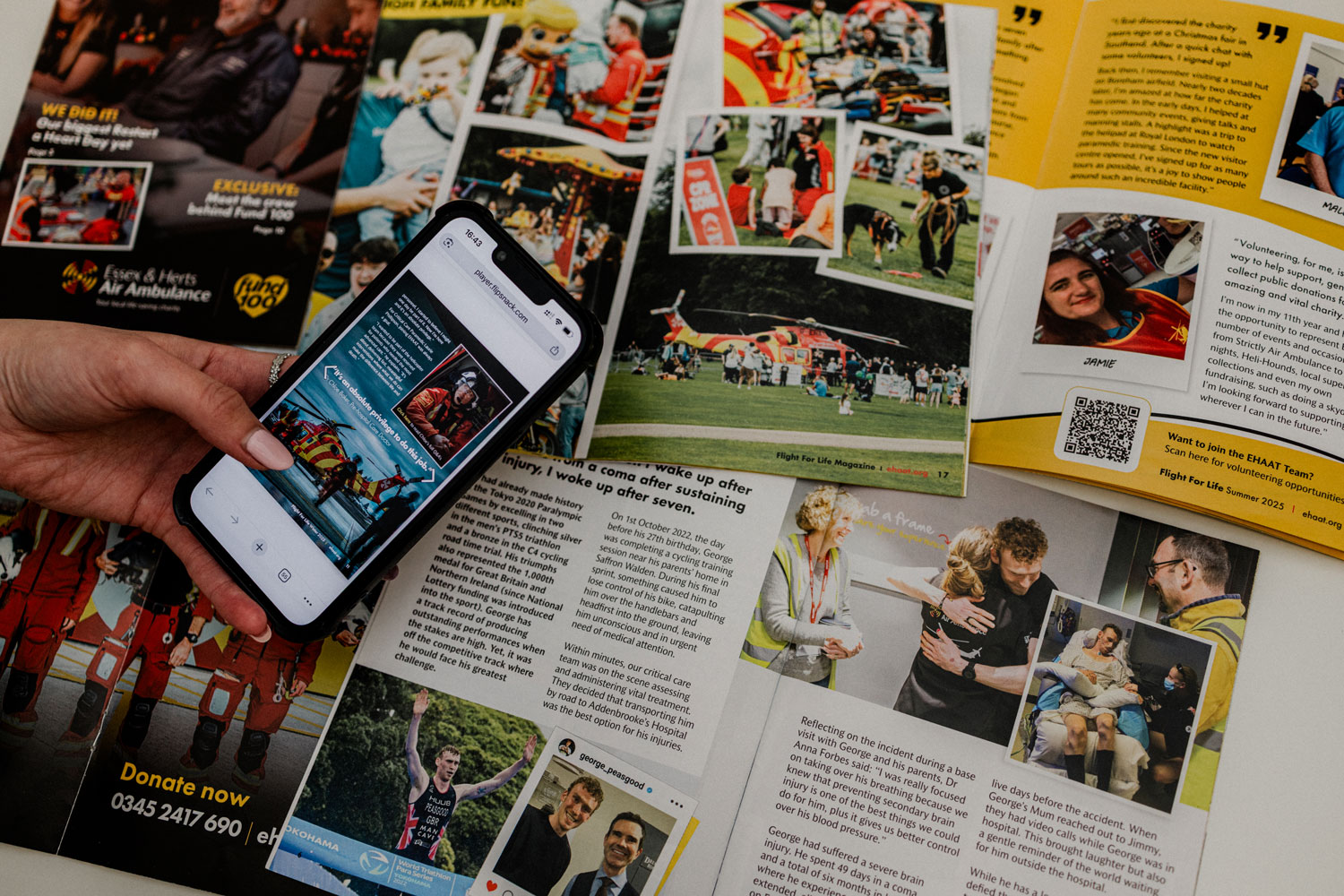

Our role spans the entire process, including magazine layouts, writing editorial copy, and producing photography that brings the stories behind EHAAT’s work to life. The focus has always been on building a consistent narrative across print and digital that reflects the charity’s impact across Essex and Hertfordshire.
Beyond the magazine, we’ve also supported photography for Strictly Air Ambulance, capturing the atmosphere and energy of the night to feed into social media, fundraising campaigns and ongoing storytelling.

It’s a good example of what happens when content, design and creative thinking come together in one place. The work isn’t defined by a single output or discipline; it’s about helping a charity communicate clearly, consistently and meaningfully.
What This Looks Like in Practice
When you place them alongside each other, the differences become clearer. This Girl Can shows how creative agencies operate, starting with insight and shaping perception through ideas. Airbnb shows how design agencies work, taking a defined identity and building a system that can scale across every touchpoint. And then there are hybrid models, like our work with Essex & Herts Air Ambulance, where those boundaries start to overlap.
In reality, most modern projects don’t sit neatly in one category. They move between thinking, design and content creation, often all at once. That’s where the lines begin to blur and where hybrid approaches become more relevant.
2026 AI
By 2026, AI is no longer something “new” in the creative industry. It’s already embedded in how agencies think, design and produce content day to day.
For agencies, it has sped up early-stage exploration. Layout ideas, colour directions and visual concepts that once took hours can now be generated in minutes. For content agencies, it’s made production faster and more scalable, helping with drafting copy, repurposing content and adapting messaging across multiple platforms. And for creative agencies, it’s become a useful tool for testing ideas quickly and exploring different campaign directions before anything is fully developed. But while the output has become faster, the expectations have gone in the opposite direction.
There’s now more content than ever across every channel, all the time. The challenge isn’t creating content anymore, it’s creating content that actually means something. Work that feels considered, consistent and relevant rather than generated for the sake of filling space.
This is where the role of agencies starts to shift again. AI can support production but it cannot decide what a brand should say, how it should behave or what it should stand for. It doesn’t understand the context between something that is technically correct and something that actually connects. That’s why creative direction and strategic thinking are becoming more important, not less. The value isn’t just in making things anymore, it’s deciding what should be made in the first place.
Content creation also continues to move towards constant output. Short form videos like reels, social-first storytelling and always on-brand activity mean that consistency matters just as much as creativity. Brands aren’t judged on one campaign anymore but on how they show up every day across multiple platforms.
The most effective work tends to come from a balance. AI can help with speed and scale but agencies help with direction, clarity and consistency. The agencies that will continue to matter in 2026 are likely to be the ones that use AI to enhance what they do, not replace it. The ones that start with thinking then move into design, content and execution, rather than the other way around.
Choosing the Right Fit: 7 Questions to Ask
Choosing between a creative, design or content agency isn’t always straightforward. As discovered, most agencies overlap in what they offer, so the real question isn’t about labels, it’s about what you actually need help with.
Here are a few simple questions that help cut through the noise.
- What’s your goal?
Start with the outcome. Are you trying to build awareness, launch something new, improve how your brand looks or stay consistently active across channels? Your goal usually points you towards the right type of support.
- Do you need strategy or execution?
Some projects need thinking first, shaping the message, direction or idea. Others already know what they want and just need it brought to life. Being clear on this avoids a lot of unnecessary back and forth.
- What’s your timeline?
Short timelines often require focused execution. Longer timelines usually allow for more exploration, testing and development. Different agency types work better at different speeds.
- What’s your budget really for?
Are you investing in a one off piece of work or ongoing output? Creative and design work is often project-based while content tends to sit in a more continuous cycle.
- How important is consistency?
If you need to show up regularly across multiple platforms, you’ll likely need ongoing support rather than one off deliverables.
- Do you need ideas, assets or both?
This is where things often blur. Some agencies focus on thinking, others on production. Many now do both but it’s worth knowing what matters most for your project.
- How involved do you want to be?
Some projects need close collaboration through workshops and feedback. Others work best when you step back and let a team run with it.
In short, the right agency isn’t the one with the right label. It’s the one that best matches the problem you’re trying to solve. Once that’s clear, everything else becomes much easier to navigate.
FAQs
Choosing between creative, design and content agencies often raise the same set of questions. Here are some of the most common ones.
Is a creative agency the same as a design agency?
Not quite. A creative agency focuses more on ideas, messaging and direction. A design agency focuses on visual execution (how those ideas actually look and feel). There’s often overlap but the starting point is different.
Do I need a content agency or a social media manager?
A social media manager usually focuses on scheduling and day-to-day posting. A content agency typically goes further, creating the content itself, including copy, photography, video and design.
Can one agency do everything?
Some can but not all do it well. Hybrid agencies combine disciplines but the quality depends on how those services are structured internally, not just what’s listed on a website.
When should I hire a creative agency?
When you’re not clear on what you should be saying. Creative agencies help shape positioning, messaging and campaign direction before anything is produced.
When should I hire a design agency?
When you already know your direction and need it turned into a professional visual identity, website or set of branded assets.
When should I hire a content agency?
When you need consistent output, especially across social media platforms and don’t have the time or internal team to produce it regularly.
What is a hybrid agency?
A hybrid agency combines creative thinking, design execution and content production. The goal is to reduce handovers and keep everything aligned from idea through to output.
How do I know what I need?
Start with the problem, not the service. Are you trying to define your message, build your brand or stay visible consistently? The answer usually points you in the right direction.
Final Thoughts
At this point, the lines between creative, design and content agencies are more blurred than ever. What matters is the outcome you need, not the label.
In summary, creative agencies focus on ideas, direction and messaging; design agencies focus on visual execution and systems; and content agencies focus on ongoing creation and consistency. However, most modern agencies now overlap across all three and the best choice often depends on your specific challenge, not the category itself.
The reality is that most brands now don’t just need one of these things; they need a combination of clarity in thinking, consistency in design and momentum in content. That’s where choosing the right partner matters.
If you’re not sure where to start or what category you fall into, that’s exactly the kind of conversation we’re happy to have. Get in touch for a free call, and we’ll help you figure out what you actually need, even if it turns out not to be us.
Sources
https://www.frameworkfilms.net/facts/history-of-creative-agencies
https://en.wikipedia.org/wiki/Advertising_agency
Ogilvy, David. Ogilvy on Advertising. Vintage Books, 1983.
Higgins, Matthew. The Rise of Creative Advertising and the Creative Revolution. Various academic marketing publications.
https://www.hubspot.com/state-of-marketing
https://contentmarketinginstitute.com/career-development/new-reality-marketing-careers
Wheeler, Alina. Designing Brand Identity: An Essential Guide for the Whole Branding Team. 5th Edition, Wiley, 2017.
Meggs, P.B. and Purvis, A.W. (2016) Meggs’ History of Graphic Design. 6th ed. Hoboken, NJ: Wiley.
https://www.redfoxvisual.com/media-and-marketing-agency/
https://www.wearebottle.com/blog/the-evolution-of-digital-pr-from-links-to-brand-authority
https://www.majortom.com/mercury-blog/the-evolution-of-the-agency
https://ehaat.org/about-us/flight-for-life-magazines/
https://www.thisgirlcan.co.uk/
https://www.sportengland.org/news/this-girl-can-returns-to-our-screens
https://www.hatchwise.com/resources/the-history-of-airbnb-and-its-iconic-logo
